
Our Time is Now
Who are your role models?

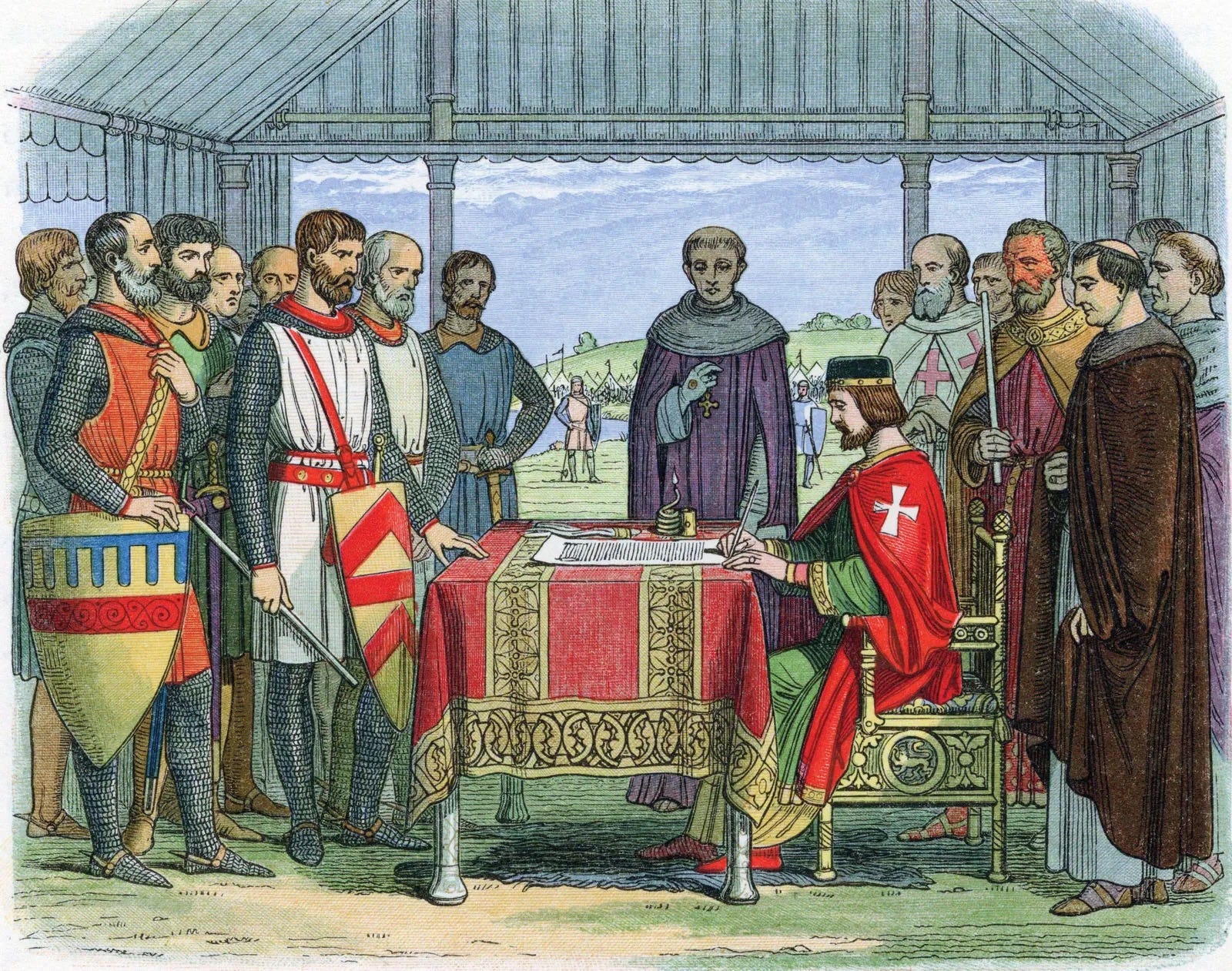
Runnymede, where King John signed the Magna Carta in June 1215, is shown with the rebellious barons who insisted that the king answer to the law rather than stand above it. With the River Thames behind them, the scene foreshadows the democratic principles that flowed from it: guaranteed rights, due process, protection against unlawful imprisonment, and justice for free men.
Welcome to Reflections on Power, Culture, and Society May 10, 2026
The right to vote has long been a project of the United States. The project we know of today as liberal democracy began in the thirteenth century.
The path from Runnymede to the Declaration of Independence, to the Emancipation Proclamation of 1863 and then Reconstruction, to Women’s Suffrage, to the courageous project of the U.S. Civil Rights and Voting Rights Act. This liberative narrative defines a people’s determination to strive for empowerment with agency and force of will, making an ever more perfect union.
That path hit a washed-out bridge on April 29, 2026.
A review of the history
RECONSTRUCTION
At the end of the Civil War, there was another time the United States of America had to decide who got to vote. The Reconstruction Amendments were three in number. They rolled out between 1865 and 1878.
The 13th Amendment (1865) abolished slavery and involuntary servitude, except as a punishment for certain crimes.
The 14th Amendment (1868) granted birthright citizenship, due process, and equal protection under the law. It penalized states that restricted voting rights for male citizens. It prohibited former Confederate leaders from holding office as Senator or Representative in Congress or elector of President or Vice President or any state, … having engaged in insurrection.
The 15th Amendment prohibited the denial of the right to vote based on race, color, or previous condition of servitude.
VOTING RIGHTS ACT [i]
The Voting Rights Act of 1965
An act “to enforce the 15th Amendment to the Constitution.
The Act prohibits certain discriminatory practices. Originally intended for racial minorities, in 1975 Congress extended the protections to “language minorities.”
It prohibits vote dilution by drawing election districts that improperly dilute minorities’ voting power.
In areas of particularly significant discrimination problems, it authorizes federal examiners to directly register voters and observe polling places.
Section 5 preclearance is a provision that precludes areas such as those described above from changing their voting laws without getting preclearance from either the U.S. Attorney General or a three-judge panel of the U.S. District Court for the District of Columbia.
The Current United States Supreme Court
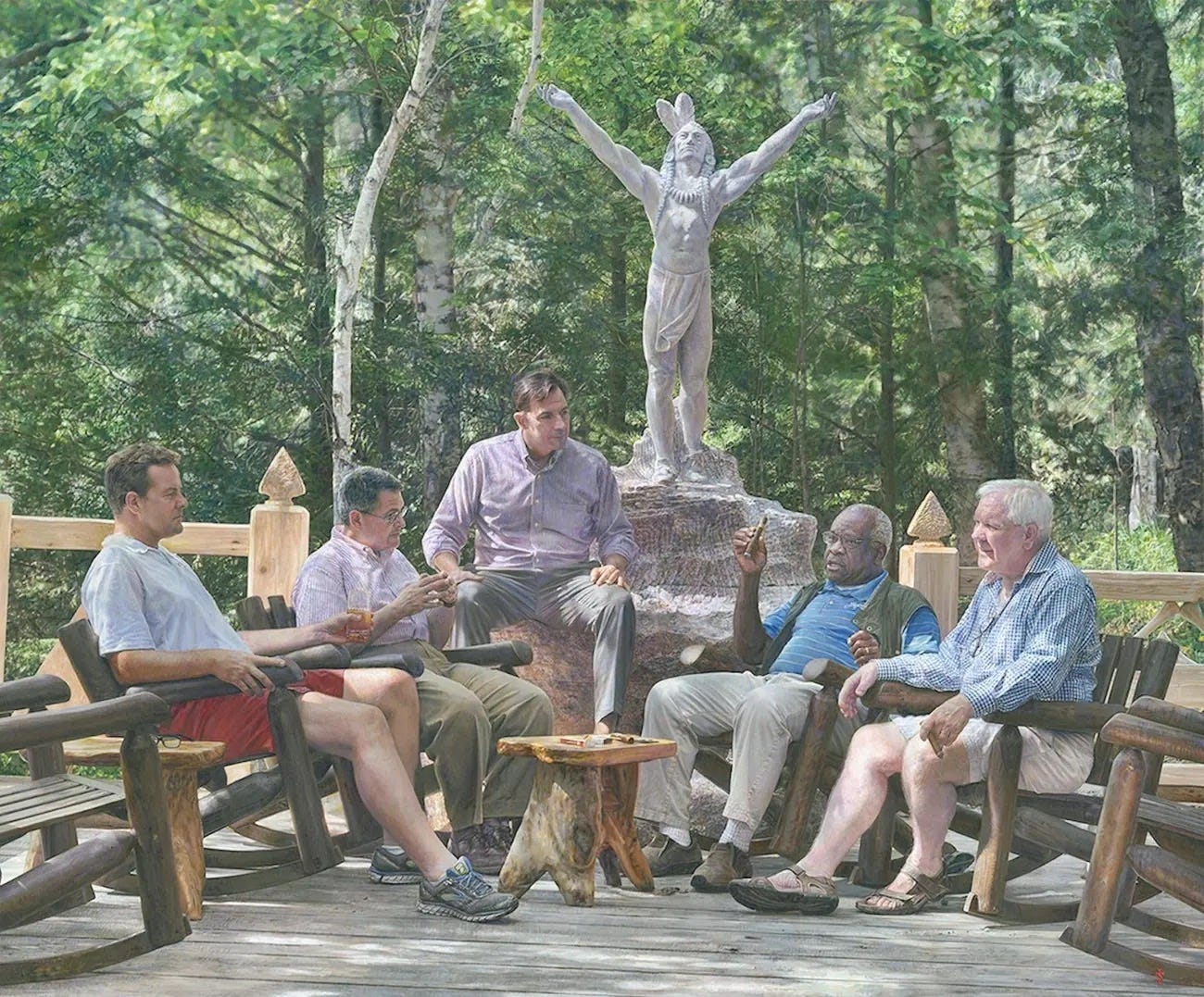
Justice Clarence Thomas on billionaire and financial supporter, Harland Crow’s patio with assorted other billionaires having a chat with the justice. Phot: Slate.com
Louisiana v. Callais:
On a Wednesday morning in April, the Roberts Court announced its decision in Louisiana v. Callais. Many legal scholars agree, pro or con, that this decision completes the destruction of the 1964 Voting Rights Act.
In a six-to-three opinion penned by Justice Samuel, Alito hollowed out what was left of Section 2 of the storied Voting Rights Act. Justice Thomas and Justice Gorsuch concurred. Justice Kagan wrote the dissent, with Sotomayor and Jackson joining her.
The ruling of Louisiana v. Callais is a hard right turn point for Section 2.
The John Roberts Court, in Callais v. Louisiana, stripped Section 2 of the Voting Rights Act of much of its force by redefining how gerrymandering is evaluated—raising fundamental questions about the viability of a multiracial democracy.
We citizens, must ask, is it possible to have free and fair democratic elections when the votes of some are watered down to the extent that their value in the tally is lost? What the Roberts Court and the other five “conservative” justices ruled is that Black people vote mostly for one ticket, so the racial considerations are not a viable concern in 2026. Party affiliation discrimination is what is crucial.
What will be the third-, fourth-, or fifth-order effects on the way power is wielded in our governments and military, cultural norms and mores are shifted, and civility is expressed in society?
This was not the first step in reversing the empowerment of non-white voters. There was the Robert’s Court’s Shelby County case in 2013 that ruled against the protections of preclearance enforcement for states that had been found to disenfranchise black and brown voters in the past. Then, in 2021, the Brnovich case raised the stakes for voters and their advocates to claim that conditions for voting were too great.
The second-order effect was in play by the next day, April 30. Republican Governor Jeff Landry of Louisiana had declared that the primary elections already underway in the state would be cancelled so new maps could be drawn[ii].
Other Southern states, including Tennessee and Alabama, have signaled they’re also prepared to redraw their maps, and Florida just did so as Callais was being handed down.
As Slate’s Richard Hasen writes, “This decision will bleach the halls of Congress, state legislatures, and local bodies like city councils, by ending the protections of Section 2 of the act, which had provided a pathway to assure that voters of color would have some rudimentary fair representation.[iii]
This will cede the ground for a massive and historic decrease of black representation in government on the theory that the Reconstruction Amendments, the Voting Rights Act, and each of the congressional reauthorizations of that act meant the precise opposite of what they intended.
Many have hailed this path toward a truly liberal democracy as the most significant congressional achievement in the nation’s history. Generations of Republican and Democratic leaders in the country have extolled. Here’s what President Reagan said when he signed an extension.
“The right to vote is the crown jewel of American liberties.”
George W Bush said, “Congress has reaffirmed the belief that all men are created equal.”
Strict Scrutiny podcast host Leah Litman interviewed Marc Alias, a super lawyer fighting scores of legal battles to keep elections fair and to hold those who would manipulate our franchise to their own ends.
The majority opinion, written by Alito, says it is undoing the dilution of votes. “We’re just updating the test that already existed and measuring it against the 15th Amendment[iv].
Marc Elaias asks,
“What’s even the argument that they’ve updated and not jettisoned Section 2? So they said they were updating the legal test for establishing a violation of the Voting Rights Act to account for a few developments in the country.
One is how political parties operate, … there is racial polarization in voting. That is, different racial groups oftentimes prefer different political parties.
A second is that the conservatives on the Court said they were updating the Act to take into account how things have changed dramatically in the South because racial gerrymandering needed to be replaced by partisan gerrymandering. (Is that Originalist?)
Third, now, when legislatures draw districts, it is legal to advantage one political party with no federal oversight that was previously enforceable through the Act. Gerrymandering is now a free-for-all for both parties to keep grinding out refreshed districts through state legislators.
For those states, primarily in the southeast, where racist discrimination and blatant disenfranchisement have in fact been effectuated, Chief Justice Roberts says, we’re all good. We are not a racist country anymore. We do not need federal oversight now. We’re all good. We’re a post-racial society.
Reflecting on power, culture, and society
What does this latest ruling do for our considerations of who we are as a country?
What will be the third-, fourth-, or fifth-order effects on the way power is wielded in our government halls, police forces, and their adjuncts and auxiliaries, for our military? As personally unidentifiable ICE and CPB still roam our streets, we see the terrified faces of children of tender age, teenagers, and young adults learning to fear those who have taken oaths to protect us.
What about our cultural norms and mores? We have already seen how lies and half-truths are treated and the destruction that causes.
Remember hearing this in old television clips from 1954, when attorney Joseph Welch asks the essential question of our day to Senator Joseph McCarthy?
It is decency and civility, as expressed in society, that define a culture. I do not mean the same expression that I have on a bumper sticker on my car, “When they go low, we go high,” in a namby-pamby way. Nice is good. Power and knowledge are better.
I mean it more in a sit up straight, tie your shoelaces, and engage your whole body, mind, and soul to the task at hand.
Project 2025 is an extension of the Powell Memo of the 1970s. This is a long-haul project. From Powell taking a seat on the US Supreme Court to the election of Ronald Reagan, big-money interests are capturing the American Dream myth.

Their move is to shift the very culture of the whole society from a multiracial, welcoming melting pot into a homogenous one that effectively marginalizes non-white people. That same pathway is at work to effectively disempower women of the liberation they have gained since the birth control pill hit the market in 1962. As soon as seminaries, law, and medical schools admitted women, enrollment hit 50%.

I do not want to insult the intelligence of my readers. You are proven resisters. You do not need to be told you must vote and get others to do the same.
There will be no false hope coming from me. The U.S. Supreme Court is not finished with this illiberal project. Nor is the DOJ, FBI, and why are so many U.S. Military leaders being fired or forced into retirement?
Reflect on real heroes. Set aside the athletes for a season. Embrace those who defeated fascism, authoritarianism, and oligarchic capture of their nations.
Vaclav Havel (Czech statesman, author, poet, playwright, dissident and political prisoner, President of the Czech Republic), Dietrich Bonhoeffer (spy, activist, d. by hanging, April 9, 1945 in Flossenbürg concentration camp), Aleksandr Solzhenitsyn (political prisoner, writer, Nobel Prize in Literature, 1970 for One Day in the Life of Ivan Denisovich) all put their full attention, intelligence, God-given talents, family resources, and all devotion to doing their part to save their country from the strangling grip of fascism.
Our time is now. These are desperate times.
On the same topic, please see these others I found rewarding.
Tim Barnicle has written a beautiful narrative of this journey of ours for seeking a more perfect union in The Broken Promise: The End of the Voting Rights Act.
Kate Shaw and Sarah Longwell discuss the Supreme Court’s action and potential consequences here.
I found the best history and detail for this travesty of free and fair elections comes from Kim Wehle, writing for the Bulwark, April 30, 2026. Professor Wehle is the Constitutional Law Professor, a Fulbright Scholar, and a former Assistant U.S. Attorney. SCOTUS Hacks Away at the Voting Rights Act Yet Again
[i] U.S. National Archives, Voting Rights Act 1965, Introduction and text of VRA
[ii] State of Louisiana, executive Department, Office of the Governor, E.O. JML 26-038, State of Emergency suspension of closed party primary elections for the offices of Representatives in the U.S. Congress, Louisiana EO
[iii] Richard L. Hasen, Slate, “The Supreme Court’s Conservatives Just Issued the Worst Ruling in a Century, Slate. Hasen
[iv] U. S. National Archives, Voting Rights Act (1965) Introduction and full transcript.